
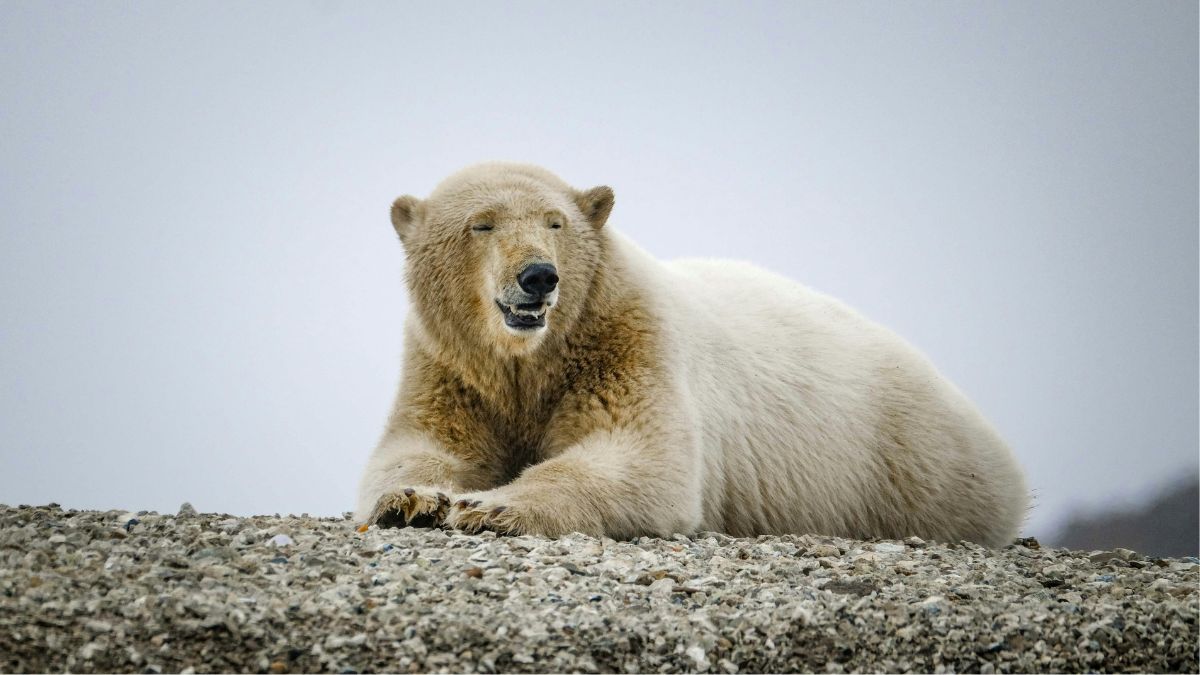
Polar Bears Claim an Abandoned Soviet Research Station as Their Own Cozy Arctic Home
Deep in Russia’s far northeast, a group of polar bears has done something that would make any real estate agent raise an eyebrow — they moved into an abandoned Soviet-era research station and made themselves completely at home. The station sits on Kolyuchin Island, roughly seven miles from the coast of the Chukotka Peninsula, a remote stretch of land that faces Alaska across the Bering Strait. Scientists abandoned the facility in the 1990s, after the Soviet Union collapsed, leaving the cluster of wooden buildings to the wind, the ice, and — as it turns out — the bears. The discovery might have gone unnoticed entirely if not for a drone, a curious photographer, and a very cooperative group of polar bears.
Travel blogger and photographer Vadim Makhorov used a drone to film the bears roaming in and out of the facility’s scattered buildings during the late summer Arctic sun on Kolyuchin Island in the Chukchi Sea. Makhorov was on a ship traveling to Wrangel Island in mid-September when he spotted the bears and launched his drone to capture the footage. What followed was a series of images and videos that stopped the internet in its tracks. One bear snapped at the drone as it approached, while others playfully poked their heads out of the buildings as they were filmed. The resulting footage was nothing short of surreal — massive predators peering out of crumbling Soviet windows like they were waiting for the mail.
Clips from Makhorov’s drone footage show a polar bear basking in the sunlight inside the doorway of a home, as well as other bears resting on porches and looking out windows. The photographer shared the images in a Facebook post that quickly captured widespread attention. “Polar bears love to occupy houses,” Makhorov wrote in the post’s caption. He seemed as charmed by the scene as everyone else who stumbled upon it, marveling at the contrast between the animals’ fearsome reputation and their surprisingly domestic behavior. “Polar bears are extremely dangerous predators, but why do they look so cute and friendly in photos?” he mused.
Makhorov also offered his own theory about why the bears had settled in so comfortably. “I think they see these houses as shelter from the wind, rain and other things,” he told Reuters. “In general, they get along fine there.” In a separate social media post, he expanded on the idea with a certain dry wit. “It’s convenient; there’s no wind, no rain. And in sunny weather, you can lie in the yard on your belly,” he wrote, apparently channeling the inner monologue of a bear who has figured out the Arctic’s best-kept secret. A nearby walrus colony and whales swimming in the surrounding waters round out what sounds like a fairly well-stocked neighborhood for a polar bear.
The gathering of so many bears in one place is itself unusual, and Makhorov pointed to warming Arctic temperatures as a likely factor. Polar bears are typically solitary animals, but they congregate when ice is scarce, coming together to find shelter and search for food. When the ice returns, the group at the station is expected to disperse. Scientists from Polar Bear International have noted that melting sea ice and other environmental changes are keeping bears closer to humans and farther from the seal lairs they typically prey on. The scene on Kolyuchin Island, as magical as it looks through a drone lens, is a vivid reminder that the Arctic is changing — and its residents are adapting in ways no one predicted.
This is not the first time polar bears have been drawn to human settlements. In 2016, a group of seven bears besieged five researchers at a weather station on a Russian Arctic island, and a passing ship had to deliver flares and deploy a helicopter to chase the animals away. The Kolyuchin encounter, fortunately, was far more peaceful — the buildings were empty, the bears were unbothered, and the only real tension was between one irritated bear and Makhorov’s drone. A 2020 study found that polar bears could be extinct by 2100 if current trends continue, lending a bittersweet quality to footage that, on the surface, looks almost whimsical.
Polar bears have a layer of fat up to four inches thick beneath their skin, which they rely on far more than their fur when it comes to staying warm in subzero temperatures. Their fur is actually transparent, not white — each hollow strand scatters light the same way snow does, creating the appearance of white. Kolyuchin Island, the unlikely setting for this whole story, was once home to an entire human village before it was fully abandoned following the Soviet collapse, meaning those bears are wandering through the ghost of a community that once bustled with scientists, workers, and families.
What do you think about polar bears moving into an abandoned research station — charming wildlife moment or a sign of something bigger happening in the Arctic? Share your thoughts in the comments.