Europe’s Largest Alpine Glacier Is Vanishing and It Serves as a Critical Source of Fresh Water
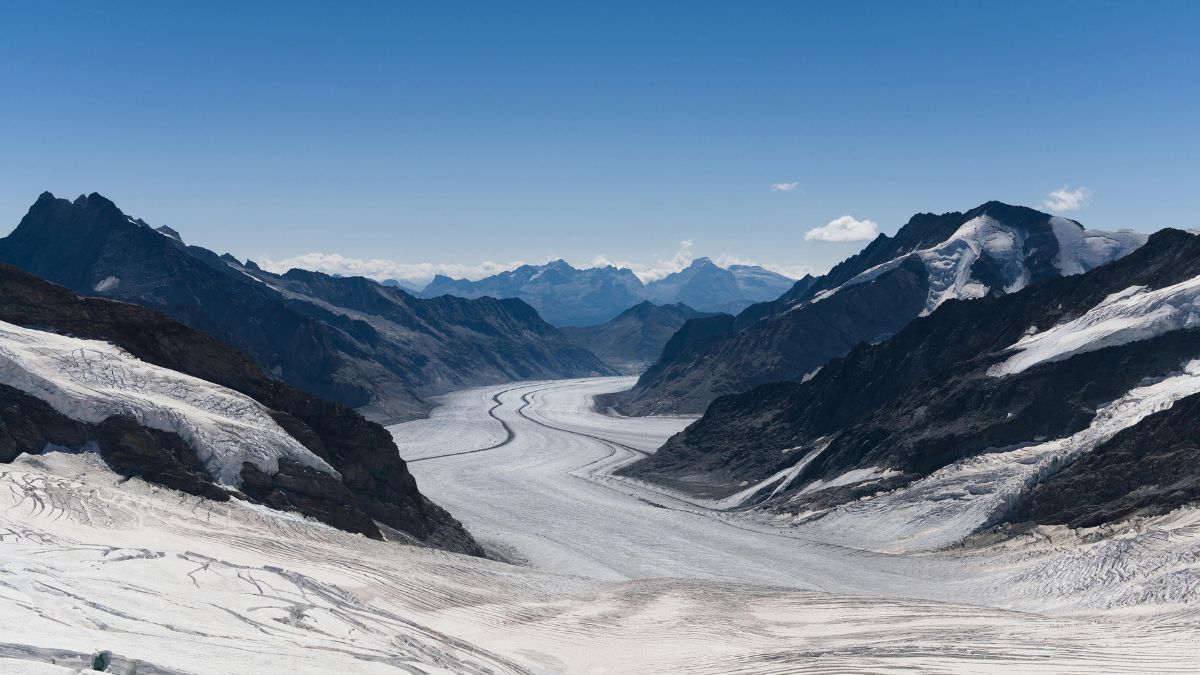
Nestled deep in the Swiss Alps between iconic peaks like the Jungfrau and the Mönch, the Great Aletsch Glacier has stood as one of nature’s most breathtaking spectacles for thousands of years. As the largest and longest glacier in the entire Alps, it has long been far more than a scenic wonder. It is a living, moving archive of Earth’s climate history and one of the most important freshwater reserves on the continent. But today, this frozen giant is in serious trouble, and its retreat is happening faster than most people realize.
Back in the early 1990s, the Aletsch stretched roughly 15 miles in length and blanketed nearly 50 square miles of the Swiss landscape. Those numbers have been shrinking ever since. Measurements show it has pulled back by as much as 164 feet in a single year, and since 1870, it has lost nearly 2 miles of its total length along with about 985 feet of its thickness. The bare rock it leaves behind tells the story better than any graph could, scarred slopes where a river of ice once flowed without interruption.
What makes this loss so alarming goes beyond the visuals. The Aletsch feeds the Rhône River and supplies water that supports agriculture and hydroelectric power across the region. While pinning down an exact figure is difficult, scientists widely agree that the glacier functions as a vital freshwater reservoir for a significant portion of Europe. Even under the most optimistic climate scenarios, projections suggest it could lose at least half of its total volume before the end of this century. In the worst case, only scattered fragments of ice might remain on the highest peaks.
There is also something almost miraculous about how this glacier actually works. It forms at a meeting point of three smaller glaciers called Konkordiaplatz, where the ice plunges to a staggering depth of nearly 2,950 feet. The entire mass weighs an estimated 10 billion tons, and despite looking completely still from a distance, it moves at around 590 feet per year at its thickest point. That slow, relentless movement has carved the dramatic U-shaped valleys and ridges that hikers explore today.
As the ice retreats, it exposes ancient forests and soils that have been buried for millennia, giving scientists a rare window into what the climate looked like thousands of years ago. Every meter of retreat is essentially a page being turned in a very long geological book. It is a remarkable silver lining to an otherwise grim situation, though researchers would clearly prefer that the book stayed closed a little longer.
The area around the glacier was recognized as a UNESCO World Heritage Site in 2001, drawing nature lovers, hikers, and photographers from every corner of the globe. Cable cars from villages like Fiesca, Riederalp, and Bettmeralp carry visitors up to panoramic viewpoints such as Eggishorn and Bettmerhorn, where the full sweep of the glacier can be seen winding between the peaks below. Trails like the Aletsch Panorama Route let you get close enough to feel the cold air rolling off the ice and hear the occasional crack and groan from deep within it.
What happens to the Aletsch Glacier is not just a Swiss problem. It is a mirror held up to the entire planet, reflecting the very real consequences of rising global temperatures. The communities, ecosystems, and power grids that depend on its meltwater cannot simply find a replacement if it disappears. Protecting it means taking the broader climate challenge seriously, not just as an environmental obligation, but as a practical necessity for future generations who deserve the chance to witness its grandeur for themselves.
If this story about the Aletsch Glacier got you thinking, share your thoughts in the comments.