Volunteers Saved a Seal From a Nearly Tragic Fate on the Cornish Coast
Along the rugged, wave-battered shoreline of western Cornwall, a young grey seal found itself in a fight for its life. The animal had become hopelessly tangled in a monofilament fishing net, the kind of near-invisible, discarded gear that poses a deadly and silent threat to marine creatures everywhere. What followed was a nail-biting race against time, one that could have ended very differently without the right people showing up at the right moment. Fortunately, a team of dedicated volunteers was ready to answer the call.
The incident began with a well-meaning attempt by a passerby who spotted the distressed seal and tried to free it by cutting away part of the net. The frightened animal, however, bolted toward the water the moment it sensed a chance to escape, and the remaining netting snagged on a nearby stretch of mussel-covered seabed. In an instant, what was already a dangerous situation became genuinely life-threatening. The seal was now completely stuck, unable to dive or flee, and the incoming tide meant that drowning was a very real possibility.
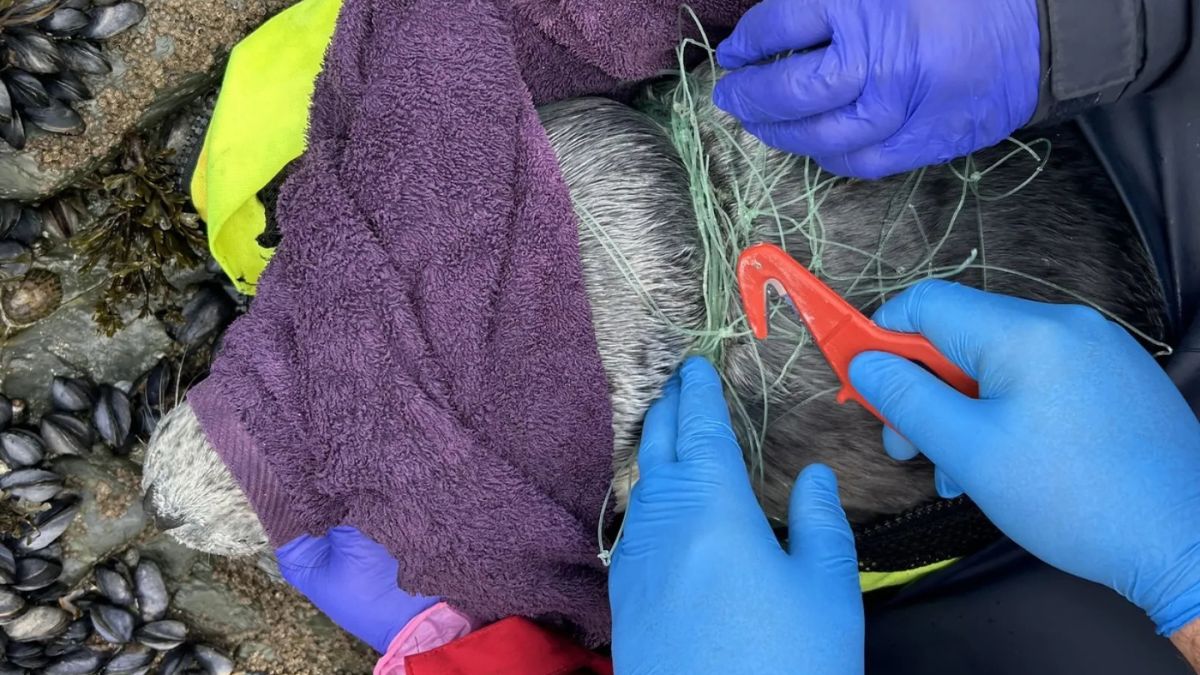
A call went out to the British Divers Marine Life Rescue, also known as BDMLR, an organization with extensive experience handling exactly these kinds of emergencies. As luck would have it, the tide began to pull back just in time, giving the rescue team a safe window to approach the animal. Working with calm precision, the volunteers carefully restrained the seal and began the painstaking task of cutting through the tightly wound netting wrapped around its neck. Every single cut mattered, and the team knew that one wrong move could cause further injury to an already stressed animal.
When the last piece of plastic was finally removed, everyone let out a collective sigh of relief. The seal had no deep lacerations, only a visible impression left on its neck from where the net had dug in. Experts noted that if the entanglement had continued much longer, the netting would have begun slicing through skin and muscle tissue, leading to serious infections that could have proven fatal. After a thorough health check, the young seal was released back into the ocean, healthy and free.
As heartwarming as this outcome was, it represents just one story among many that never get a happy ending. Abandoned, lost, and discarded fishing equipment, widely referred to as ghost gear, is considered one of the most destructive forces currently threatening ocean ecosystems around the world. According to Greenpeace, this type of waste accounts for a significant share of all plastic pollution found in our oceans today. Estimates suggest that roughly 640,000 tons of ghost gear end up in the sea every single year, a weight comparable to more than 50,000 double-decker buses.
Unlike other forms of marine debris, ghost gear does not simply float away and become harmless. Nets, ropes, and traps continue to catch and kill wildlife for decades, sometimes even centuries, after they are first lost or thrown overboard. Animals including seals, dolphins, sea turtles, and whales are all vulnerable to becoming entangled. The World Wildlife Fund has repeatedly warned that these entanglements inflict a slow and agonizing death through suffocation, drowning, or starvation, making ghost gear one of the cruelest and most overlooked threats in our oceans.
The BDMLR volunteers who rushed to this seal’s rescue are a reminder of what dedicated, trained individuals can accomplish when they choose to act. Their work is made harder by the sheer volume of hazardous material drifting through our waters, and public awareness plays a massive role in driving the change needed to tackle it at scale. Stories like this one matter because they put a face, or rather a pair of whiskers, on a problem that can otherwise feel abstract and distant.