Rare Footage Shows How the World’s Most Isolated Tribe Reacted to Contact with Outsiders
Deep in the Indian Ocean sits North Sentinel Island, home to the Sentinelese people who have chosen to remain cut off from the rest of the world for tens of thousands of years. This small community fiercely guards its isolation, and outsiders who venture too close often face arrows and hostility. Yet one remarkable encounter from decades ago captured their reaction in a way that still fascinates anyone who sees the resurfaced clip today. The footage offers a rare, brief window into a group that otherwise stays hidden among the dense jungle and coral reefs.
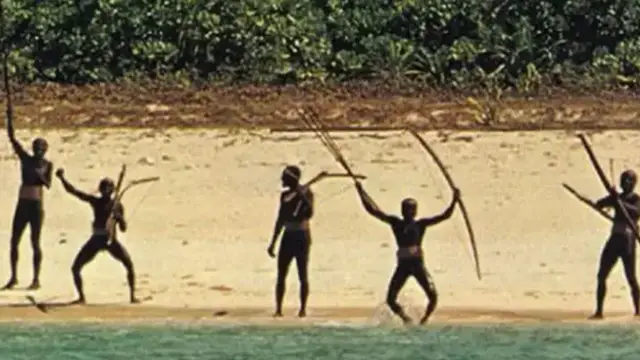
The video dates back to January 4, 1994, when Indian anthropologist Trilokinath Pandit and his team approached the island by boat. As they drew nearer, members of the Sentinelese tribe emerged from the trees to meet them on the shore. Instead of immediate aggression, the group showed clear curiosity mixed with caution. They accepted some coconuts and other small gifts offered from a distance, handling the items with evident interest while keeping a watchful eye on the visitors.
What stands out in the old recording is the tribe’s mix of openness and wariness during that single peaceful exchange. Men, women, and children appeared, observing the outsiders without launching attacks. Pandit and his colleagues maintained a respectful distance throughout, never forcing further interaction. Moments like these remain exceptional because the Sentinelese have a long history of rejecting contact, often with deadly force to protect their way of life.
The Sentinelese continue to live as hunter-gatherers, relying on the island’s resources for everything from food to shelter. Estimates suggest only around 50 to 200 individuals make up the entire population, though no one knows the exact number for sure. They craft bows, arrows, and spears from local materials and build simple huts amid the tropical forest. Their resistance to the modern world has kept them safe from many diseases that devastated other indigenous groups after first contact.
Footage from 1991 captures one of the few friendly encounters with the inhabitants of North Sentinel Island. 😲pic.twitter.com/QshhgnInVo
— GFY TV (@Viralvid_89) August 21, 2025
Tragic events underscore why their isolation matters so much. In 2018, American missionary John Allen Chau tried to approach the island multiple times to share his faith. The tribe killed him, and his body was never recovered. Indian authorities chose not to retrieve it or punish the Sentinelese, respecting the tribe’s autonomy and the legal protections around the island. No one is allowed to visit, and boats must stay at least several miles away to avoid any risk.
Earlier incidents reveal the dangers from both sides. In the 1970s and 1980s, a few attempts at friendly contact succeeded briefly, including the 1994 meeting shown in the footage. Yet shipwrecks and illegal fishing trips have sometimes ended in violence when outsiders drifted too close. The tribe has scavenged metal from old wrecks to improve their tools, showing they adapt what washes ashore without welcoming the people who bring it.
Recent satellite imagery has added new layers to our distant view of the island. Compiled Google Earth clips from early 2026 reveal faint signs of camps, clearings, and movement among the trees, hinting at daily life continuing unchanged. These overhead glimpses come from safe, high-tech observation rather than risky landings. They remind us that the Sentinelese thrive on their own terms, far from the influences that have transformed nearly every other corner of the planet.
Protecting such uncontacted groups involves a delicate balance. The Indian government enforces a strict no-contact policy to shield the tribe from outside germs and interference while preserving their right to self-determination. Experts agree that sudden exposure could wipe out the population through illness alone, given their lack of immunity to common diseases. At the same time, the footage from over thirty years ago sparks ongoing wonder about what brief, careful encounters can teach us.
The Sentinelese stand as one of the last examples of humanity living completely apart from global society. Their story invites reflection on respect for different ways of life and the value of leaving some places untouched. As technology brings us closer looks from afar, it also reinforces the importance of boundaries.
What are your thoughts on how we should approach the Sentinelese and their island in the comments.