A Woman Spotted a Kitten Hiding Outside and Never Gave Up Until the Little Cat Finally Decided to Trust
It started with a moment of chance. Earlier this year, a woman named Chloe was pulling into the parking lot of her apartment complex when something small caught her eye. She quickly realized it was a kitten with an injured leg, but before she could get close, the terrified animal darted under parked cars and disappeared. Chloe refused to walk away. For the next several days, she returned to the spot with food and water, determined to find the little one again.
When she eventually spotted the kitten sheltering in nearby woods, she turned to her neighbors for help. Through that search, she was connected with Catz 4 Life, a volunteer-run rescue organization. Their TNR coordinator, Laura, arrived the very next day with a humane trap, and within 15 minutes, hunger won out over fear. “She was only about 12 weeks old. She was so small that she didn’t set off the trap at first,” Chloe told Love Meow. “She ate two cans of food that first night.”
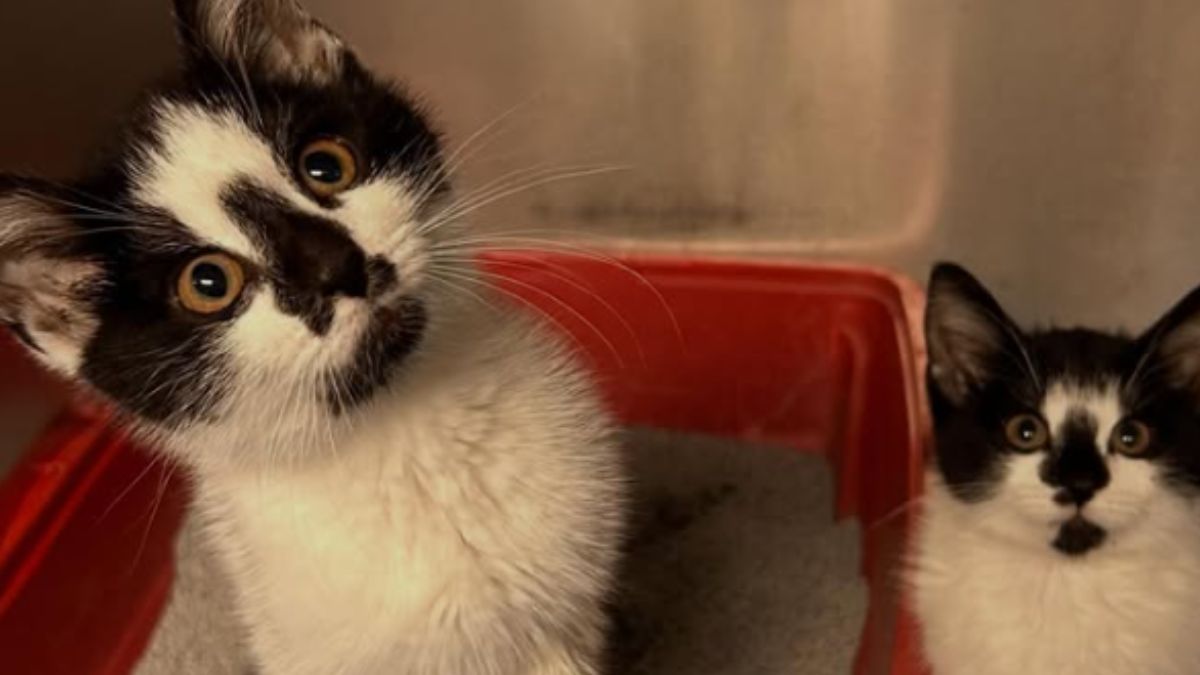
Chloe named the kitten Willow and created a quiet, safe space for her filled with blankets, food, water, and toys. But Willow was not ready to trust anyone just yet. She hid constantly and hissed every time Chloe entered the room. “She refused to leave her hiding spot while I was in there for the first week.” Then came a small but unmistakable turning point. Midway through a hiss, Willow’s expression shifted and a tiny meow slipped out instead. “I think that was the moment we both realized she knew she was safe.”
From there, Willow began to open up bit by bit. She started showing interest in toys and cautiously approached Chloe for attention, only to spook herself and retreat. “But she kept coming back out. She was so scared, but she wanted love so badly.” Around this same time, it became clear that Willow’s injured leg could not be saved. The decision was made to amputate it, giving her the best possible chance at a comfortable, pain-free life.
Willow’s recovery was nothing short of remarkable. She attempted to walk almost immediately after surgery, wobbly but driven. Within days she was batting at a feather wand while lying on her side, and two weeks later she was walking and exploring her surroundings with full confidence. Three legs turned out to be no obstacle at all for a cat with her kind of determination.
As weeks passed, the fearful stray who once hid behind a toilet had transformed into a curious, affectionate companion. “When I first got her, she was so paralyzed by fear and pain that she basically had no personality. She didn’t even know how to play,” Chloe reflected. “Now, she’s a completely different cat. She’s grown, gained weight, and no longer scarfs down her food in minutes.” Willow even invented her own game, tossing her favorite toy mouse into a tunnel and then hunting it down herself.
Chloe had originally planned to foster Willow until the right forever home came along. But while away for a few days, she couldn’t stop thinking about her. When she returned, Willow snuggled into her hand and purred the entire drive home. A few days later, Willow climbed onto the couch on her own for the very first time and curled up beside Chloe. “I knew then that we were bonded for life.” Chloe reached out to Aimee, president of Catz 4 Life, to make it official. “She must have sensed a shift in my energy after I told Aimee that I wanted to adopt her, because she became even more affectionate.”
Today, Willow greets Chloe with meows, hovers around her feet at mealtime, and even insists on supervising litter box cleanings. Though she remains shy with strangers, she is completely devoted to the woman who never gave up on her. “As soon as I sit down on the couch, she’s at my feet asking to join. She purrs until she falls asleep, and she loves to stretch out on my lap.” For Chloe, the feeling is entirely mutual. “I’m glad she gets to stay with me, where she’s comfortable and knows she’s safe and loved.”
Cats that have had a limb amputated are commonly called “tripods” or “tripawds” in the rescue world, and studies show they adapt to three legs so efficiently that most owners report their pets show no significant change in quality of life. Feral and stray kittens that are socialized before the age of four months have a much higher chance of becoming fully domesticated companions, which is part of why early rescue efforts like the one that saved Willow matter so much. TNR programs, like the one Catz 4 Life runs, have been shown to be more effective at managing stray cat populations long-term than traditional catch-and-euthanize methods, according to research from multiple animal welfare organizations.
If Willow’s story touched your heart, share your thoughts about rescue animals and second chances in the comments.