A Vet Was Told It Was “Disgusting” to Let Cats on Furniture. His Response Went Viral
Few debates among pet owners are as enduring as whether cats should be allowed on the furniture. Most cat owners will tell you there was never really a choice in the matter, but every so often someone feels compelled to weigh in with a strong opinion from the outside. One Kentucky veterinarian recently found himself on the receiving end of exactly that kind of unsolicited judgment, and his response sent the internet into a frenzy.
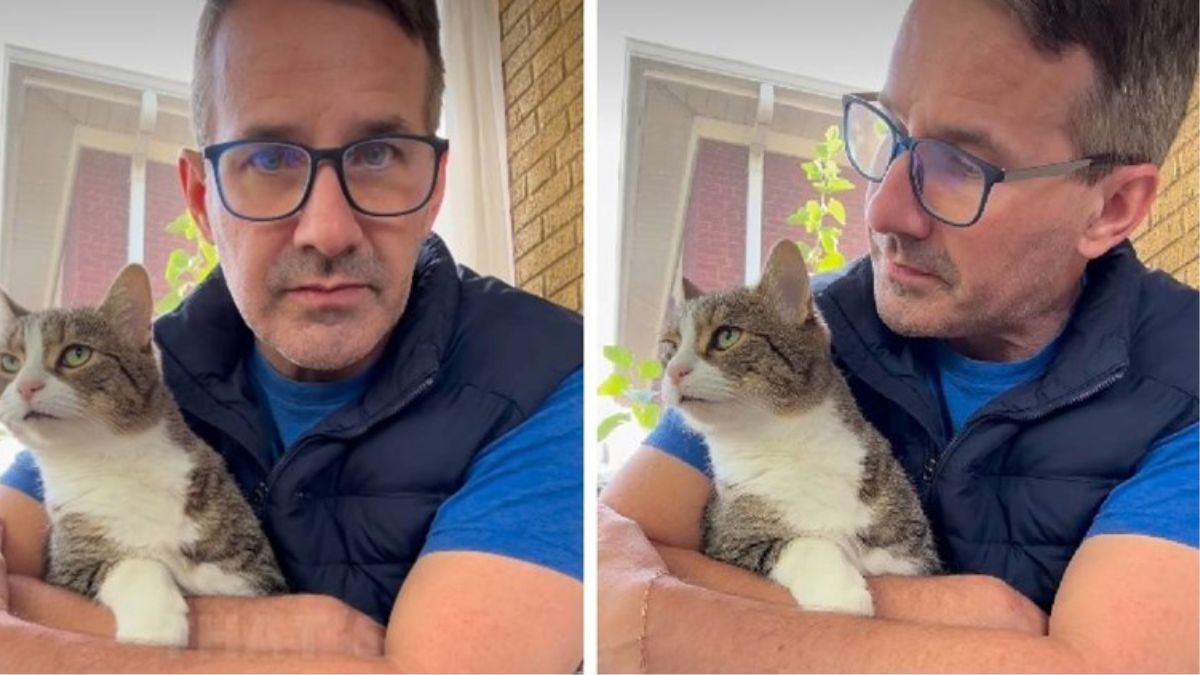
Dr. Matt McGlasson is a veterinarian and the chief medical director at Noah’s Ark animal clinics in Kentucky, where he oversees a network of four hospitals. Outside of his professional life, he is the devoted owner of a special-needs cat named Rupaul, who is unable to use her hind legs. According to McGlasson, who spoke with Newsweek about the recurring experience, he receives comments every single week from people telling him it is disgusting to allow cats on furniture. One viewer went so far as to call him “revolting.”
Rather than ignore the criticism or offer a measured rebuttal, McGlasson responded the way only a truly devoted cat owner could: with a deadpan, escalating list of every extreme thing he would do for Rupaul. The video, filmed while he held his cat in his arms, racked up an extraordinary 11.8 million views on Instagram and sparked an outpouring of responses from cat owners around the world who felt deeply, personally seen.
In the clip, McGlasson ran through an increasingly absurd set of concessions he would make for his cat. He said he would co-sign a loan for her, let her manage his personal finances, hand over the passwords to all of his accounts, go into business with her, and pay her $20,000 for bringing home a dead mouse. He also mentioned that while he generally opposes the death penalty, he would reconsider that position “if someone ever hurt Rupaul.” The list concluded, of course, with the perfectly reasonable act of allowing her to sit wherever she pleased on the furniture. His summary of the arrangement was characteristically matter-of-fact: “My cat can do whatever she wants. It’s her world, and I just live in it.”
The comment section quickly filled with fellow cat owners who had their own stories to share, each one more devoted than the last. One woman explained that when her husband was shopping for a new armchair, the width of the armrest was a non-negotiable factor because their cat needed to be able to sit comfortably beside him whenever she wanted company. Another commenter joked that they would donate both kidneys to their cat if the situation ever called for it. A third offered what may be the definitive statement on the matter, responding to a hypothetical question about whether their cat slept with them by saying, “Ma’am, I would let him represent me in court.”
Perhaps the most touching contribution came from an owner who shared the story of his senior cats. He wrote that he had purchased a house specifically so he could move out of his apartment and give his aging cats the chance to feel grass beneath their paws one more time before the end of their lives. It was the kind of comment that brought an unexpected lump to the throat, tucked right between the jokes.
What the viral moment captured so perfectly is something cat owners have always known but rarely get to say out loud in a crowd that will understand: the relationship between a person and their cat is not always logical, and it is not supposed to be. It operates on its own terms, in its own quiet language, and if that language occasionally involves relinquishing the better half of the couch, then that is simply the arrangement.
Dr. McGlasson’s video resonated not because it was outrageous but because it was honest. Behind every exaggerated concession was the genuine truth of what it means to share your home with an animal who has claimed it as thoroughly as you have. Rupaul, for her part, appeared entirely unbothered by the attention.
Cats have a specialized region in their brains dedicated to processing the sounds of their owner’s voice, which is separate from how they process other human speech, meaning your cat genuinely does recognize you as distinct from everyone else. Ancient Egyptians shaved their eyebrows as a sign of mourning when a household cat died, and the grieving period continued until the eyebrows grew back. Domestic cats spend roughly 70 percent of their lives asleep, which means that if a cat lives to 15 years old, it will have been awake for only about four and a half of them.
If you have a cat who runs the household, share your stories in the comments!