
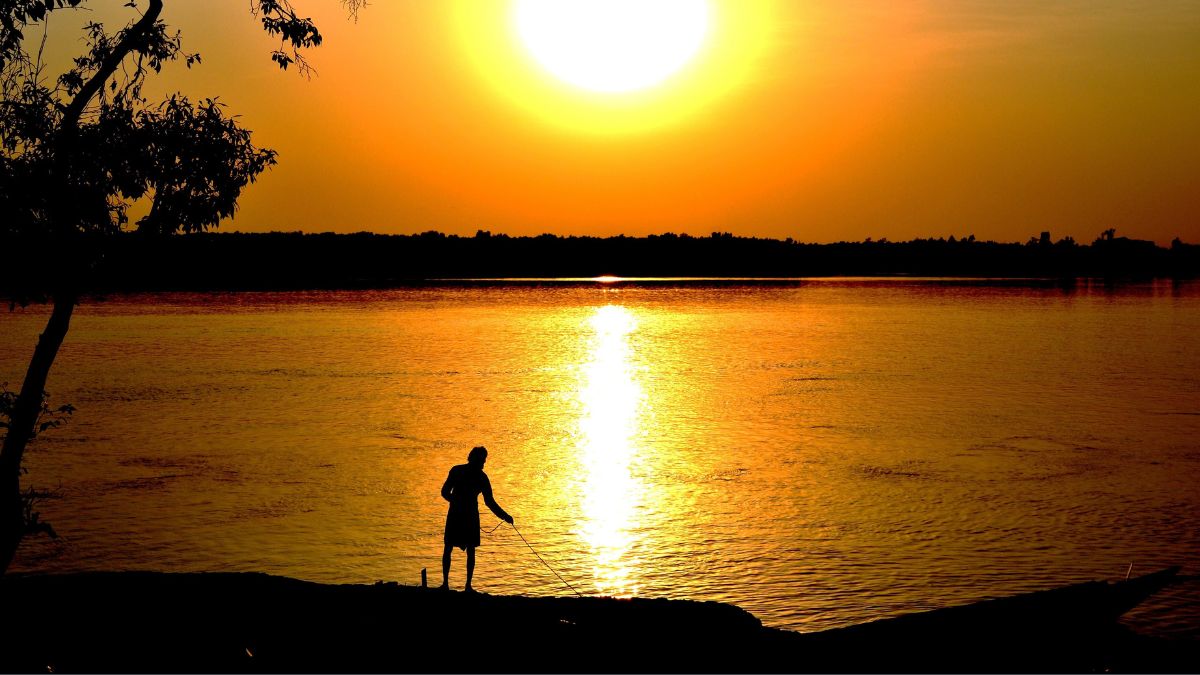
Visit This Place Before It Disappears From the Planet Forever
There are places on Earth that feel like they exist outside of time, ancient, wild, and untouched by the modern world. The Sundarbans is one of them. Stretching across roughly 10,000 square miles along the border of Bangladesh and India, it is the largest mangrove forest on the planet. A UNESCO World Heritage Site, it is home to Bengal tigers, crocodiles, spotted deer, and hundreds of bird species. But scientists are increasingly worried that this extraordinary ecosystem may not survive the century.
The Sundarbans acts as a natural shield for millions of people living along the Bay of Bengal. Its dense tangle of roots and waterways absorbs the force of cyclones and storm surges, reducing the devastating impact on coastal communities. Without this living barrier, entire villages would be completely exposed to the fury of the ocean. It is not just a forest but a lifeline, one that is slowly being swallowed by the sea it once held at bay.
Rising sea levels and extreme weather events have been eating away at the Sundarbans for decades. Since 1964, roughly 210 square kilometers of land have been lost to the encroaching sea, according to research by Zero Carbon Analytics. In 2020, Cyclone Amphan tore through the region and left behind more than $14 billion in damage, displacing millions of people in both Bangladesh and India. A recent study found that between 2000 and 2024, somewhere between 10 and 15 percent of the forest has lost its ability to recover from environmental stress, a phenomenon researchers describe as “critical slowing down.”
The consequences for local communities are already devastating. Families in coastal villages are abandoning their homes and moving to the capital city of Dhaka, joining the estimated one to 1.5 million other climate migrants from southern coastal communities who have already relocated there, according to Atiq Rahman, director of the Bangladesh Center for Advanced Studies. The World Bank projects that by 2050, more than 13 million Bangladeshis could be forced to migrate due to climate-related crises, with those living near the Sundarbans among the most affected. In some areas, the situation has already passed the point of sustainability, with saltwater flooding farmland and destroying the livelihoods people have built over generations.
Industrial development and newly planned dams are adding further pressure to an already fragile ecosystem. These projects threaten to disrupt the freshwater flow that mangroves depend on to survive. Deforestation and land-use changes continue to chip away at the forest’s natural defenses. Scientists watching thousands of square kilometers of this so-called water forest disappear are raising urgent alarms that the world has been slow to answer.
And yet, the Sundarbans remains one of the most breathtaking places you could ever visit. Traveling through its labyrinth of rivers by boat, spotting a Bengal tiger slipping between the roots, or hearing nothing but the splash of water and the calls of birds is an experience unlike anything else on the planet. It is also a place where you can see, firsthand, what climate change looks like in real time, written in the eroding mudbanks and the salt-bleached stumps of dead trees. Visiting it is not just tourism, it is bearing witness.
If there is one destination that deserves to be on every traveler’s list right now, it is this one. Not only because of its breathtaking beauty and incredible wildlife, but because the window to experience it in its current form is genuinely closing. The locals who have lived alongside the forest for generations are asking where they will go when the last wall between them and the ocean is gone, and that is a question all of us should be asking too. Share your thoughts on the disappearing Sundarbans in the comments.