The Stray Kitten Who Arrived at a Shelter Looking Like a Tiny Balloon Is Winning Hearts Everywhere
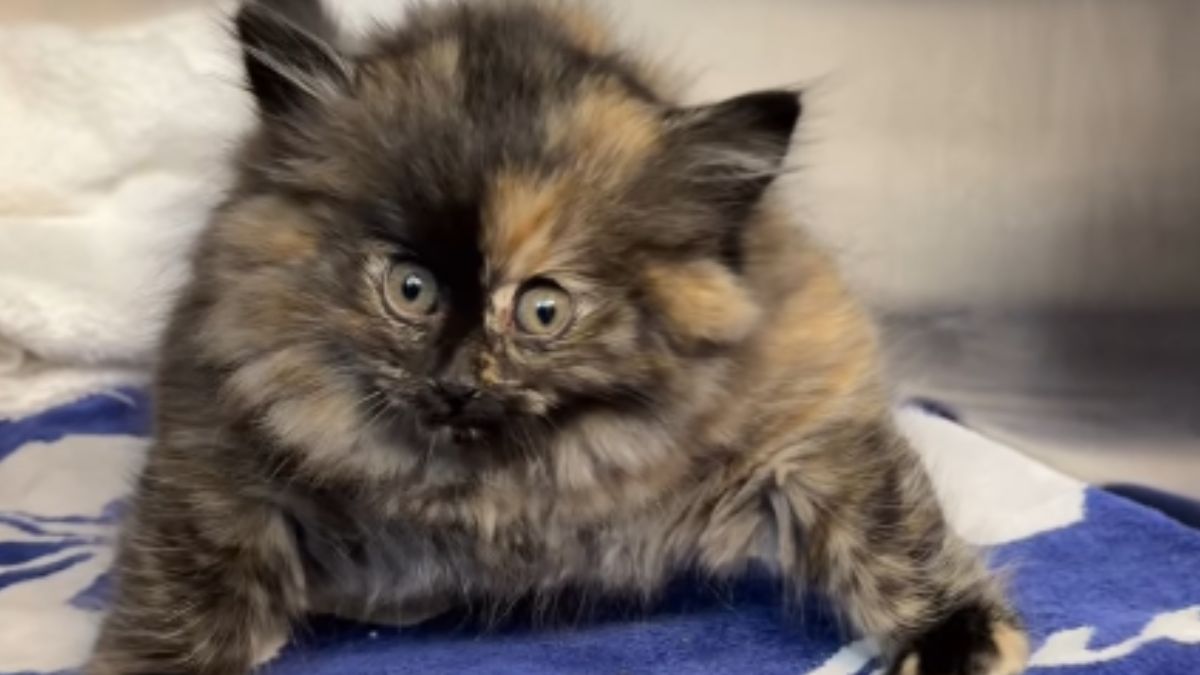
When a stray kitten showed up at a California animal shelter looking like she had been pumped full of air, the staff knew immediately that something was very wrong. The little tortoiseshell, quickly named Zoe, appeared shockingly swollen, her tiny body puffed out in a way that was both alarming and heartbreaking. Veterinarian Dr. Phil Caldwell took on her case and documented the whole experience on his Instagram account, giving followers a front-row seat to one of the strangest medical situations he had ever encountered. What could have been a tragedy quickly became a story of resilience, skilled veterinary care, and an internet full of people desperate to see a puffy kitten pull through.
Dr. Caldwell’s initial examination left little doubt that Zoe’s condition was unlike anything he had seen in a long time. After taking X-rays, his team confirmed she was suffering from subcutaneous emphysema, a condition in which air becomes trapped beneath the skin. The trapped air had spread through the soft tissue layers beneath her fur, giving her entire body an inflated, balloon-like appearance. When Caldwell gently pressed on her sides during the examination, the extent of the air buildup was immediately obvious, and the footage of this moment quickly became the clip that launched Zoe into viral stardom.
“This is the craziest veterinary case I’ve seen in quite some time,” Caldwell said in the video. “She’s so sweet… yet she’s filled with air. She’s blown up like a blimp. Oh my gosh, she’s like a big puffball. We’ll do our best to save her.” Despite the severity of her situation, Caldwell’s tone remained calm and determined, and that reassurance mattered deeply to the thousands of people who watched the clip and immediately fell in love with the tiny, puffy stray. His team got to work stabilizing Zoe and monitoring her closely while the trapped air slowly began to dissipate on its own.
Subcutaneous emphysema in animals can result from trauma, infections, or injuries that allow air to enter the tissue layers beneath the skin. In Zoe’s case, veterinarians suspected the air buildup was likely related to damage to her windpipe, though the exact cause of her injury as a stray was unknown. The condition can look terrifying but is treatable when caught early, with veterinary care focused on addressing the underlying cause and allowing the body to reabsorb the trapped air gradually. Zoe’s team monitored her around the clock, and the careful, patient approach began to show results faster than many had dared to hope.
The response from the public was immediate and overwhelming. Viewers flooded the comments section of Caldwell’s post with messages of support and prayers for the little tortoiseshell. “Oh my gosh, what can we do besides pray?” one commenter wrote. “Sweet angel is in the best care.” Another viewer added, “Please do everything in your power to make sure this little one lives a long, full life… possibly with me.” The warmth of the response reflected just how deeply Zoe’s story had resonated, turning a frightening veterinary case into a moment of collective hope.
In a follow-up update, Caldwell delivered news that had everyone breathing a little easier. “Zoe update! Everyone’s favorite puff kitty is making progress and looking much better, though she’s not out of the woods yet,” the caption read. The visible change in her appearance between the first video and the follow-up was remarkable, with Zoe already looking noticeably less swollen. She was eating, resting, and responding well to care, and the veterinary team remained cautiously optimistic about her continued recovery. For a kitten who had arrived looking like a furry little balloon, the progress was nothing short of extraordinary.
Stories like Zoe’s are a reminder of what shelter veterinary teams quietly accomplish every day. They take in animals whose histories are unknown, whose injuries are sometimes bizarre and baffling, and they show up anyway, armed with knowledge, patience, and a refusal to give up. Zoe had no owner advocating for her, no medical history to reference, and no obvious explanation for how she ended up in the state she was in. What she had was a skilled, dedicated team and the kind of stubborn sweetness that made everyone who met her want to fight for her.
Subcutaneous emphysema is so rare in cats that many veterinarians go their entire careers without encountering a single case, which is part of why Zoe’s X-rays stopped the room. Tortoiseshell cats, by the way, are almost exclusively female due to the genetics of coat coloring, with male torties occurring in roughly one in three thousand births and almost always being sterile. The crackling sensation veterinarians feel when pressing on skin affected by subcutaneous emphysema actually has its own name in medical circles, called crepitus, and it is one of those things that, once you know it exists, you cannot stop thinking about.
What would you do if you found a stray animal in such an unusual condition? Share your thoughts in the comments.