
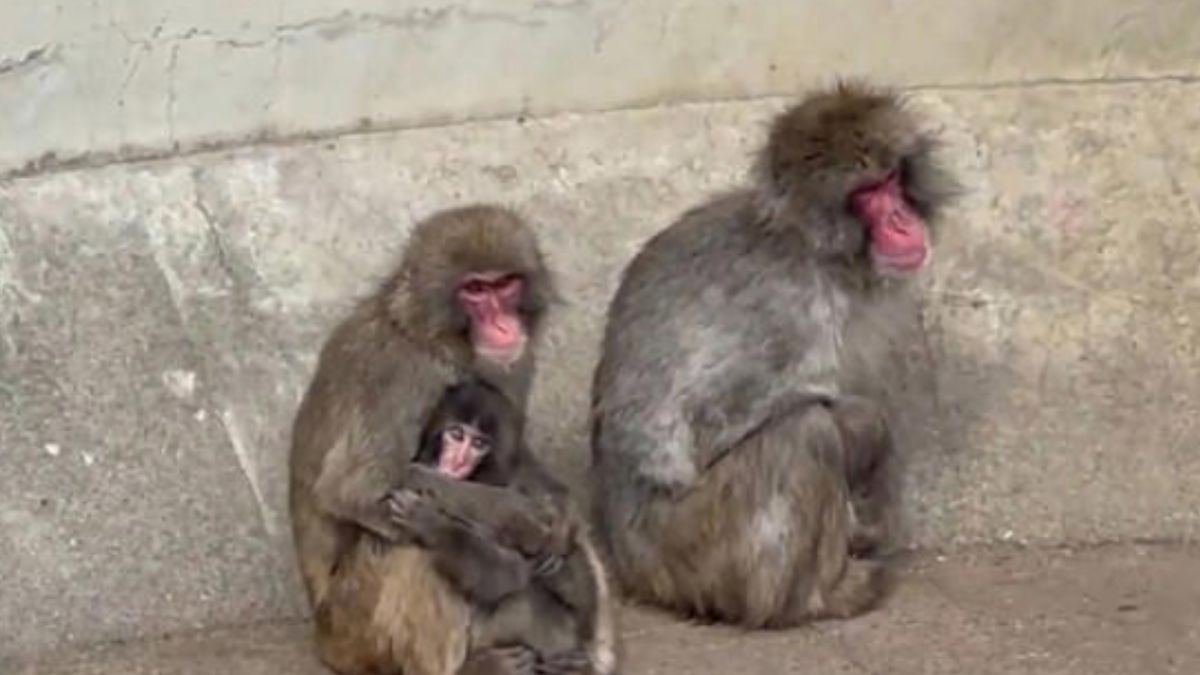
The Heartwarming Moment When Other Monkeys Finally Welcomed Little Punch Into Their Troop
For months, the internet held its breath over the fate of a tiny monkey named Punch. Born in July 2025 at the Ichikawa City Zoo near Tokyo, Japan, this seven-month-old Japanese macaque entered the world under difficult circumstances. His mother, likely overwhelmed by the stress of giving birth during an intense summer heatwave, abandoned him shortly after he was born. Zookeepers stepped in immediately, hand-raising the fragile infant and searching for ways to give him the comfort he so desperately needed. What followed became one of the most followed animal stories in recent memory.
To help Punch cope, zookeepers introduced him to a stuffed orangutan from IKEA — the Djungelskog model — which quickly became his most treasured possession. The toy, affectionately nicknamed “Ora-mama” by fans, gave the little macaque something warm and fuzzy to cling to, a critical developmental need for baby monkeys who build strength and security through physical contact with their mothers. Zookeeper Kosuke Shikano explained the reasoning behind the choice: “We thought that its resemblance to a monkey might help Punch integrate back into the troop later on.” Within days, videos of Punch dragging his plushie everywhere he went spread across social media, racking up tens of millions of views and turning the small zoo into an international destination.
When the time came to introduce Punch to the wider monkey troop in the enclosure, things did not go smoothly at first. Other macaques ignored him, shoved him, and in some cases dragged him across the ground, sending shockwaves of concern through his growing online fanbase. Primatologist Sarah Turner from Concordia University in Montreal offered some reassurance, noting that while the scenes looked alarming, they were not entirely unusual. She explained that babies typically learn how to socialize from their mothers, and in Punch’s case, he simply had no teacher. Zoo staff echoed this, noting that the disciplinary moments were actually part of how young macaques learn the rules of troop life. As Ichikawa Zoo stated, “Punch has been scolded many times and has learned to socialize.”
Still, fans were anxious. The hashtag HangInTherePunch went viral, and comments flooded in from around the world. “I would adopt Punch and love him forever,” one person wrote online, while another admitted, “3 days in a row crying over Punch.” The concern was real and widespread. Content creator Chris Olsen even flew to Tokyo specifically to visit Punch and offer moral support, later sharing on Instagram: “Yeah im crying cause I flew to Tokyo to tell a monkey who’s being bullied that he’s loved and then I saw him get a hug, why wouldn’t I be crying??” His posts showing Punch being embraced by fellow troop members sent fans into an emotional frenzy.
That pivotal moment of acceptance came on February 20, when an adult monkey named Onsing drew Punch into a firm embrace. User @dondawastaken captured the footage and shared it widely with the caption: “After enduring days of rejection, Baby Punch finally experienced the comfort of love. Today, the adult monkey Onsing drew little Punch into a firm, deeply reassuring embrace.” Grooming and hugging between monkeys are among the most significant signals of social acceptance in primate culture. The fact that Onsing extended that gesture to Punch was not just touching to watch — it was a genuine milestone in his development.
By early March, new videos and photos confirmed that Punch was no longer on the fringes of his troop. He was seen hopping onto older monkeys’ backs for rides around the enclosure, receiving affection freely, and even taking cues from adults on how to shelter from the rain. Zookeeper Shumpei Miyakoshi shared that “He’s actively engaging with other monkeys, and I can feel he’s growing up.” Importantly, Punch has not entirely abandoned his beloved plushie just yet — he still carries it around and sleeps with it every night. Zoo director Shigekazu Mizushina explained the long-term hope: “When he grows out of the plush toy that encourages his independence, and that’s what we are hoping for.”
After enduring days of rejection, Baby Punch finally experienced the comfort of love. Today, the adult monkey Onsing drew little Punch into a firm, deeply reassuring embrace. pic.twitter.com/SnCdsDZ5kl
— ✮ راينر براون (@dondawastaken) February 20, 2026
The response beyond social media has also been remarkable. IKEA Japan donated several replacement orangutan plushies to the zoo, with Ichikawa City Mayor Ko Tanaka publicly announcing the contribution. Monthly zoo visitors more than doubled, and the Djungelskog stuffed animal sold out in multiple countries, with bidding wars erupting on resale platforms. Morten Kringelbach, a neuroscientist from Oxford University, noted that seeing something adorable triggers a pleasure response in the brain “within a seventh of a second,” which partly explains why Punch’s story spread so fast and hit so hard.
Japanese macaques, also called snow monkeys, are the northernmost-living nonhuman primates in the world and are famously known for bathing in hot springs during winter — a behavior that researchers believe is both thermoregulatory and a way to reduce social stress within the troop. The IKEA Djungelskog stuffed animal that Punch made famous is based on a real species, the Bornean orangutan, which is critically endangered in the wild with fewer than 70,000 individuals remaining. And Punch’s viral rise mirrors a landmark 1950s study by psychologist Harry Harlow, who discovered that baby monkeys, when given a choice between a wire “mother” that dispensed food and a soft cloth one that offered only warmth and comfort, consistently chose the softer option — proving that emotional security matters just as much as physical nourishment.
What do you think about Punch’s journey — share your thoughts in the comments!


