
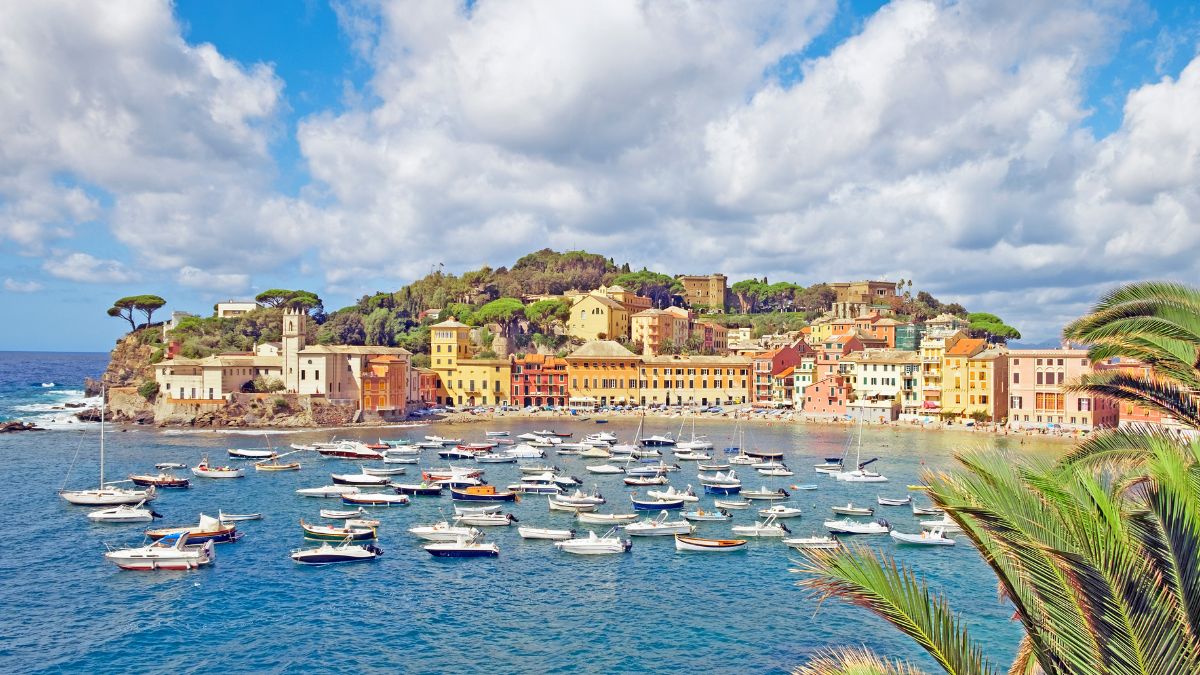
The European “City of 2 Seas” Is Going Viral on TikTok and Has Welcomed Some Famous Names
As warmer weather draws near and travel planning kicks into high gear, one small Italian town has been quietly stealing the spotlight on social media. Sestri Levante, a coastal gem on the Ligurian Riviera tucked between Genoa and the Cinque Terre region, has become a genuine TikTok sensation in recent months. Known locally as the “City of Two Seas,” it offers something increasingly rare along the Italian coast: atmosphere without the crush of mass tourism.
What makes Sestri Levante so visually arresting is its geography. The historic town center sits on a narrow strip of land that was once a small island before gradually connecting to the mainland over centuries. That slender stretch of earth now divides two entirely distinct bays, each with its own character, name, and mood. Together they form the natural spectacle that has captivated visitors for generations and, more recently, audiences scrolling through travel content online.
On one side lies the Baia delle Favole, or Bay of Fables. According to local sources, the name was given to the bay in the 1950s by Italian television personality Enzo Tortora, who coined it in honor of Hans Christian Andersen, the beloved Danish author of fairy tales who spent time in Sestri Levante during the 19th century. On the other side rests the Baia del Silenzio, the Bay of Silence, a name first associated with the poet Giovanni Descalzo in 1919. The Baia del Silenzio is widely considered one of the most photographed views in all of northwestern Italy and ranked sixth among Italian beaches in TripAdvisor’s Travelers’ Choice Beaches selection in 2018.
The town’s appeal extends well beyond its natural setting. Sestri Levante has a layered history that stretches back to antiquity, when it was known as Segesta or Segeste and founded by the Ligurian Tiguli tribe. Through the medieval period it fell under the influence of the Republic of Genoa, and it weathered pirate attacks in both 1542 and 1607. The main thoroughfare, Via XXV Aprile, winds through the historic center past vividly colored facades, some decorated with the painted architectural illusions of trompe l’oeil, a technique that makes flat walls appear three-dimensional.
Over the centuries the town attracted a remarkable roster of distinguished visitors. Local tourism sources cite Hans Christian Andersen, composer Richard Wagner, inventor Guglielmo Marconi, and Dutch writer Arthur van Schendel among those who passed through or stayed. Marconi’s connection to the area is commemorated by the Torre Marconi, a tower where he reportedly conducted early experiments related to radio communication.
The business community in Sestri Levante is protective of what the town has managed to preserve. Nicolò Mori, president of the local business association Sestri Levante In, told Forbes that “Sestri Levante is not that well known and we like it that way,” adding, “We would not want to become Cinque Terre because it would destroy the authenticity of the city.” That sentiment resonates strongly in an era when many beloved Italian destinations have buckled under the pressure of overtourism.
@fabletrips A hidden gem not far from Genova 😍 #sestrilevante #genova #genoa #italytravel #travel #fyp #viral #drone #liguria #portofino #cinqueterre ♬ sonido original – Cinnamon Girl
Strolling through the town reveals layers of history woven into everyday life. The church of San Nicolò dell’Isola, constructed in the Romanesque style in 1151, is the oldest in the city. Santa Maria di Nazareth, built in the 17th century, later took over as the main parish church. The Palazzo Durazzo-Pallavicini houses the town’s municipal administration, while the Palazzo Fascie is home to MuSel, the local archaeological and civic museum whose collection spans from prehistoric times through more recent history. The Galleria Rizzi functions as both a house museum and gallery space.
Sestri Levante’s culinary identity is rooted firmly in Ligurian and Mediterranean tradition, with a strong emphasis on fresh fish, olive oil, and aromatic herbs. The town and the neighboring area of Riva Trigoso are particularly associated with bagnun, a hearty soup made from anchovies, onion, tomato, and olive oil that has deep ties to the local fishing community. An annual festival dedicated to the dish has been held since 1960. Pesto alla genovese, focaccia, and anchovies prepared in various ways are other staples found across the local dining scene.
For travelers considering a visit, Sestri Levante sits at a moderate price point by Italian coastal standards. According to Numbeo, a meal at an inexpensive restaurant runs around $24, while dinner for two at a mid-range spot costs approximately $75. A cappuccino is about $1.30, and a small bottle of water around $1.60. Grocery staples are similarly accessible, with a standard loaf of bread priced near $3. Visitors should also note that a tourist tax applies from March 1 through October 31 in 2026.
The Baia del Silenzio is so narrow that at certain times of year the water laps within just a few feet of the buildings lining its shore, giving the bay an almost theatrical, stage-set quality that makes it unlike almost any other beach in Europe. Hans Christian Andersen wrote letters during his stay in Sestri Levante describing the town in glowing terms, and some historians believe the unique landscape of the two bays may have influenced his storytelling imagination. The word “Ligurian” itself derives from an ancient pre-Indo-European root, making the region’s name one of the oldest continuously used geographical labels in all of Italy.
Have you ever visited Sestri Levante or a similarly underrated coastal town in Europe? Share your thoughts in the comments.


