
Record-Breaking Great White Shark Contender Is Back on the East Coast and Scientists Are Watching His Every Move
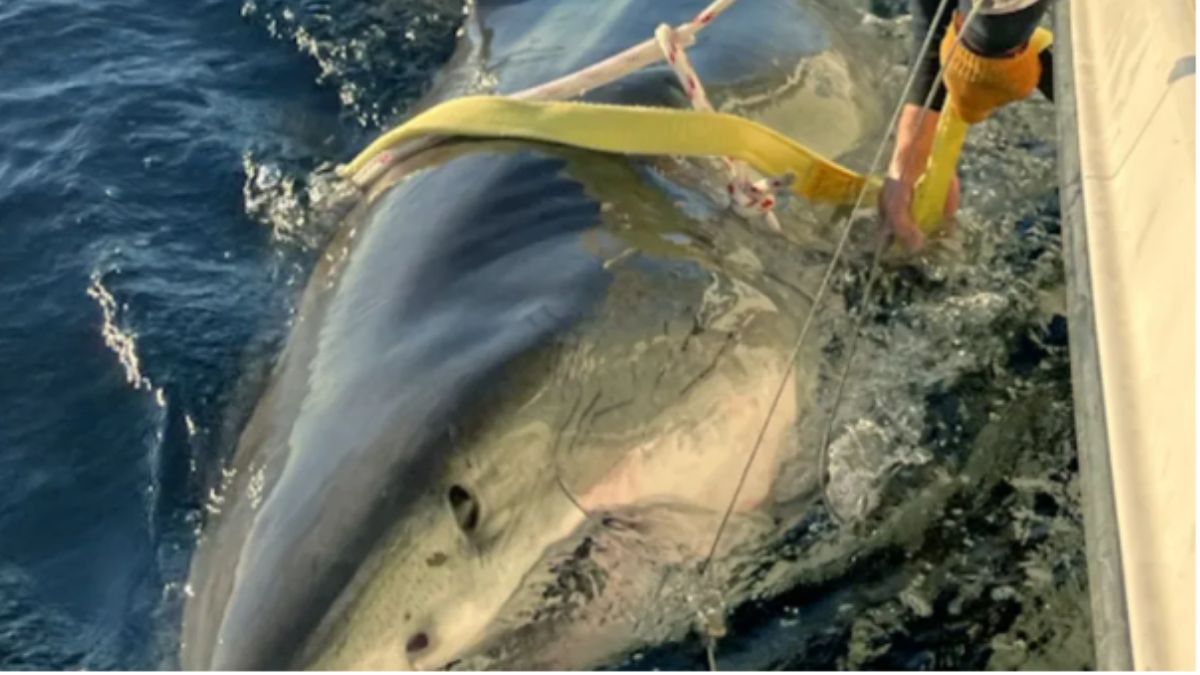
He is 14 feet long, weighs around 1,653 pounds, and holds the title of the largest male great white shark ever tagged in the western North Atlantic. His name is Contender, and he has been making waves — literally and figuratively — as he cruises back along the eastern coastline of the United States. Tagged by the nonprofit research organization OCEARCH in January 2025, near the Florida-Georgia line, Contender has since logged an extraordinary amount of ocean miles as scientists track his every ping. His return has coincided with spring break season, giving beachgoers along Florida’s northeast shore something remarkable to think about while they’re in the water.
Since being tagged, Contender has traveled up the coast, spending extended periods around the Carolinas, venturing as far north as Canadian waters, and then making his way back south again to the Florida coast. His movements follow the well-worn migratory paths of great white sharks, who tend to pursue prey and warmer temperatures in a seasonal rhythm that scientists are still working to fully understand. OCEARCH founder Chris Fischer has described Contender as spending time off Canada eating seals constantly and swimming in front of seal colonies, putting on weight before heading back down to Florida for the winter. The shark’s journey north and south reads almost like a working vacation — one spent consuming as much as possible before the long swim back.
Contender’s most recent ping placed him just off the coast near St. Augustine, along Florida’s northeast shoreline, an area especially busy during spring break as beaches fill up and temperatures rise. While the idea of a shark of this size lurking offshore might sound alarming to anyone planning a beach day, researchers are quick to offer some reassurance. OCEARCH researchers emphasize that sharks like Contender typically stay miles offshore and pose little risk to beachgoers. Great whites are not known to target humans as prey, and even when accidental encounters do occur, marine biologists note that sharks almost always disengage quickly.
What makes Contender particularly exciting to the scientific community goes beyond his sheer size. Chris Fischer said researchers hope to gain new insight into the largely unknown reproductive habits of great white sharks, noting that “of the few clues we have, it seems like we need to be paying attention to the late winter and early spring area.” Great white shark mating has never been directly observed, and no confirmed mating site has ever been identified anywhere in the world for any of the species’ nine populations. OCEARCH data scientist John Tyminski explained that “based on some indirect evidence, we think that mating occurs somewhere in the southeast United States around late winter, early summer period,” adding that Contender is “offering some clues” and that researchers will be watching his movements alongside mature females like a tagged shark named Goodall. Every ping Contender sends is another data point in a mystery that marine scientists have been trying to crack for decades.
Fischer has also raised the question of whether Contender will cross paths with other mature male white sharks like Breton and mature female white sharks like Goodall during this period, calling the months ahead critical for assessing whether his movements are related to mating behavior. The timing of his return to southeastern waters, right as other tracked sharks are also active in the region, is not lost on the research team. Contender is not traveling alone in a broader sense either, as several other large great white sharks have been tracked across U.S. waters in recent weeks, including a shark named Bella detected off Florida’s Gulf Coast near Sarasota. The clustering of so many large sharks along the southeastern coastline at the same time is a reminder of just how active and populated these waters truly are beneath the surface.
For those wondering how Contender stacks up against the largest sharks ever recorded, he still pales in comparison to Deep Blue, a female great white first documented in 1999 off Guadalupe Island in Mexico, who is said to measure around 20 feet long and weigh over two tons. Still, for a male specimen, his size is extraordinary by any measure. OCEARCH named him Contender after the group’s Florida-based partner, Contender Boats, Inc., giving the shark a name that suits his heavyweight status in the world of marine research.
Great white sharks can actually go weeks or even months without eating when food is scarce, relying on their livers — which can make up nearly a third of their total body weight — as an energy reserve for long migrations. The species has existed in roughly its current form for around 11 million years, making it far older than the earliest humans. And despite being famously associated with the 1975 film ‘Jaws’, real great whites are estimated to live between 40 and 70 years, making some of them older than many of the people terrified by that movie.
Have you ever followed a tagged shark’s journey online, and would you want to track Contender’s movements in real time? Share your thoughts in the comments.