
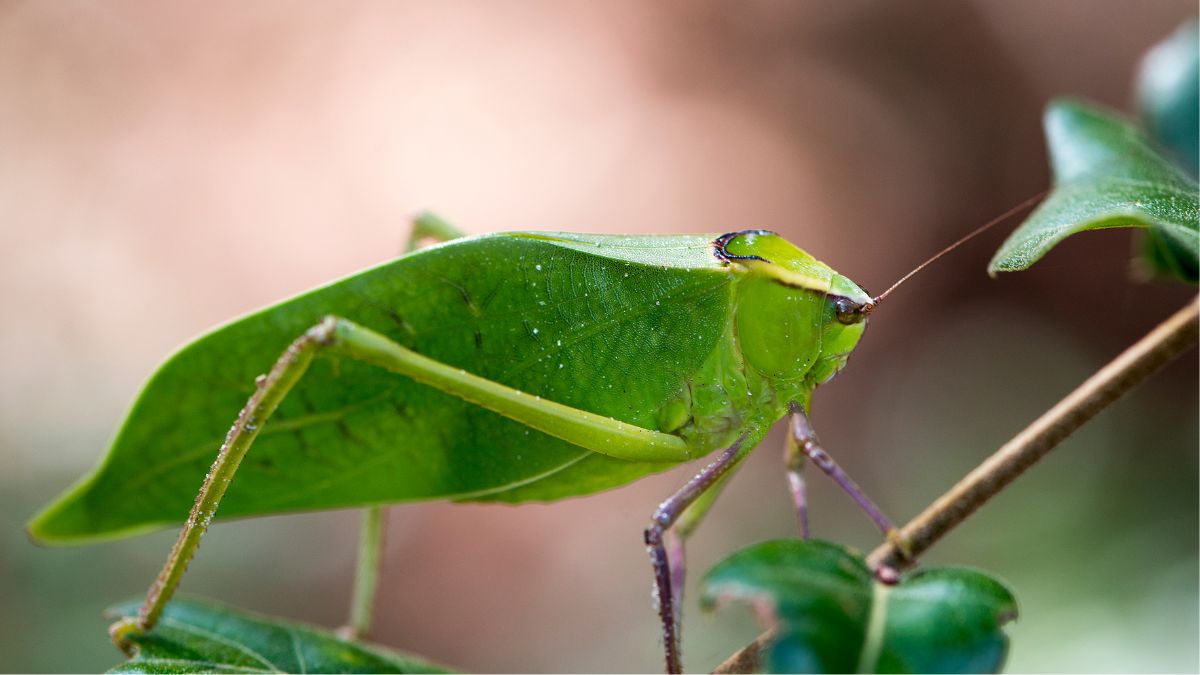
People Are Scratching Their Heads at This Wild Animal Hiding in Plain Sight
Imagine walking through a lush trail in Illinois’ McHenry County Conservation District, surrounded by vivid foliage and birdsong, when you suddenly sense that you are not alone. You scan the brush around you and see nothing. Yet the feeling persists — something nearby is watching, perfectly still, perfectly silent, waiting for you to pass. Then a nearby bush trembles almost imperceptibly, and your invisible trail companion gives itself away. You have just been fooled by one of McHenry County’s most talented masters of disguise: the katydid.
The McHenry County Conservation District is home to at least 22 different species of these remarkable insects, a fact that surprises most people who have spent time outdoors in the area without ever noticing one. “A walk in nature can be a constant game of ‘I Spy!'” the MCCD wrote on Facebook, and nowhere is that truer than on a summer trail thick with green undergrowth. Katydids are so effective at blending into their environment that even experienced hikers walk right past them without a second glance. Their disguise is not accidental — it is the product of millions of years of evolutionary fine-tuning.
Wildlife ecologist Cindi Jablonski discovered this firsthand during a recent hike when a common true katydid paid her a quiet, uninvited visit. The insect, which resembles a grasshopper at first glance, has one crucial distinguishing feature: a leaf-like appendage extending from its back that makes it nearly indistinguishable from surrounding foliage. This leafy backside is far more than a visual curiosity. As the MCCD explained on Facebook, “this common true katydid (Pterophylla camellifolia) blends in with leaves like those of this spicebush in order to avoid getting eaten by predators such as birds.” That one adaptation is essentially the difference between life and death in the wild.
McHenry County’s katydid population is impressively diverse, ranging from the fork-tailed bush katydid to the common true katydid and many varieties in between. All of them tend to thrive during the summer months, when the vegetation is at its densest and greenest and camouflage works most effectively. During this time, the insects are virtually invisible to the untrained eye, tucked between layers of overlapping leaves in a sea of identical green. Most people have no idea how many of these creatures surround them on a typical summer walk through the county’s conservation areas.
As summer fades into autumn, however, the dynamic shifts in a fascinating way. The foliage begins to turn gold, amber, and brown, and suddenly the katydids’ green coloring works against them rather than for them. “As plants begin to change colors, it is a great time to spot insects that blend in with their surroundings during greener months,” the MCCD noted on Facebook. What was once an almost supernatural ability to vanish into a background becomes a bright green flag waving against a canvas of fall color. For anyone who has wanted to finally see one of these elusive creatures up close, early autumn is the ideal window of opportunity.
Even when they cannot be spotted by sight, katydids have a reliable backup method for making their presence known. “You may hear these singing insects at night around this time of year,” the MCCD wrote on Facebook. That distinctive, rhythmic chirping filling the warm night air is actually the katydid’s calling card, produced by rubbing their wings together in a behavior called stridulation. It is one of the most recognizable sounds of summer and early fall in the American Midwest, even if most people have never connected the sound to its source.
Katydids got their name from the sound they produce — early American colonists thought the chirping sounded like the phrase “Katy did, Katy didn’t” repeated over and over again. Unlike crickets, which rub their legs together to create sound, katydids use their wings, and each species produces a slightly different rhythm that experts can use to identify them by ear alone. The common true katydid is one of the loudest insects in North America relative to its body size, capable of producing calls that carry for hundreds of feet through a quiet evening forest.
Have you ever spotted a katydid in the wild, or been fooled by one hiding in plain sight? Share your story in the comments.