
China’s Mysterious Imperial Tombs Have Been Guarding a Lost Civilization for Centuries
At the foot of the rugged Helan Mountains in northwestern China, where sandy winds sweep across the plains of Yinchuan, a forgotten civilization has quietly slept for nearly a thousand years. Rising from the earth like ancient sentinels, a series of massive earthen mounds have stood watch over the secrets of the Western Xia dynasty for centuries. These are the Xixia Imperial Tombs, and until recently, much of the world had no idea they even existed. That changed in a big way when, at the 47th session of the World Heritage Committee held in Paris, the site was officially added to the UNESCO World Heritage List, becoming China’s 60th recognized location under that prestigious designation.
The tombs belong to the Western Xia dynasty, which ruled from 1038 to 1227 and was founded by the nomadic Tangut people. For nearly two centuries, this empire thrived right at the crossroads of the ancient Silk Road, holding its own against powerful neighboring dynasties including the Liao, Song, and Jin. The Tanguts were fascinating cultural architects, weaving together their own traditions with influences drawn from the Han, Uyghur, and Tibetan peoples to create something entirely unique. Tragically, their brilliant civilization was brought to an abrupt end by the Mongol conquest in the 13th century, and because the subsequent Yuan dynasty never compiled an official history of the Western Xia, enormous amounts of knowledge about these people simply vanished.
That loss of historical record is a big part of what makes this site so captivating. The tombs spread across nearly 40 square miles, housing nine imperial mausoleums and more than 270 accompanying burial sites, all arranged on a north-to-south axis in accordance with Feng Shui principles and celestial alignments. This is currently the largest and best-preserved archaeological site from the Western Xia period, making it a physical testament to an empire that history almost completely swallowed up.
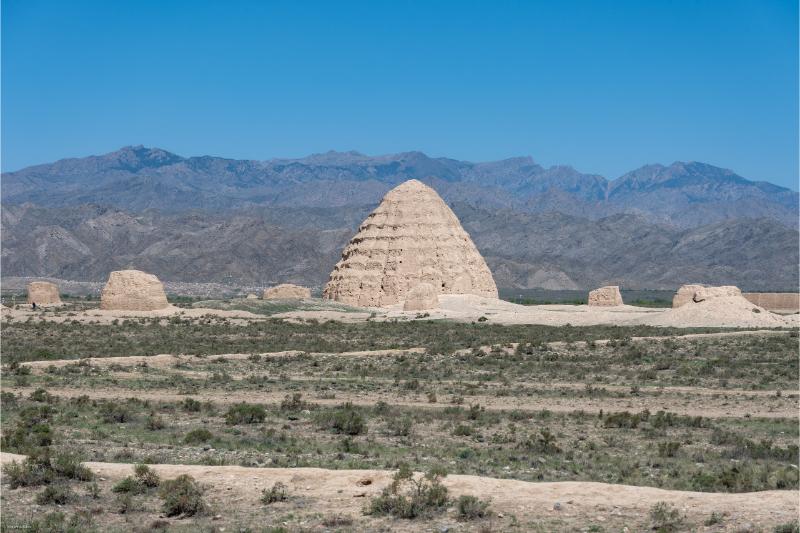
What really sets these tombs apart visually is their striking architecture. Rather than stone structures, the central mausoleums are densely packed earthen forms that taper upward into octagonal pagoda-like shapes, some of which once stood nearly 65 feet tall. Centuries of wind and erosion have worn away their outer layers and decorative elements, but their silhouettes still dominate the landscape in a way that has earned them the nickname “Oriental Pyramids.” UNESCO specifically praised the site as an outstanding example of cultural blending, noting that the spatial design draws on the grand imperial mausoleum traditions of the Tang and Song dynasties while also incorporating strong Buddhist elements and distinctly Tangut burial customs. Each individual mausoleum functioned as its own architectural complex, comparable in scale and intention to the famous Ming Tombs outside Beijing.
Preservation efforts began in earnest in the 1970s, and since 1988 the site has held national protected monument status in China. Authorities have carried out more than 60 major structural reinforcement projects on the earthen mounds, and roughly 100,000 square feet of modern construction was cleared away to restore the integrity of the landscape. Those efforts were specifically highlighted by UNESCO as a model of responsible heritage stewardship. Over nearly five decades of excavation, archaeologists have unearthed more than 7,000 artifacts at the site, including a gilded bronze bull and fragments of stone steles inscribed in both Chinese and the still-mysterious Tangut script.
Even with all that scholarly attention, an aura of genuine mystery still clings to the place. Local residents have passed down stories for generations claiming that grass never grows on the burial mounds themselves, and that birds refuse to land on them, as if nature itself acknowledges some kind of sacred boundary. Whether or not you believe those tales, there is something undeniably powerful about standing in the presence of a civilization that the world once forgot entirely. The UNESCO designation is more than a bureaucratic honor; it is a promise that the story of the Tangut people, their culture, and their role along the ancient Silk Road will never be allowed to disappear again.
If you find ancient lost civilizations and mysterious archaeological sites as fascinating as this one, share your thoughts in the comments.