The Mystical Devil’s Bridge in Germany Defies the Laws of Nature with a Mind-Bending Optical Illusion
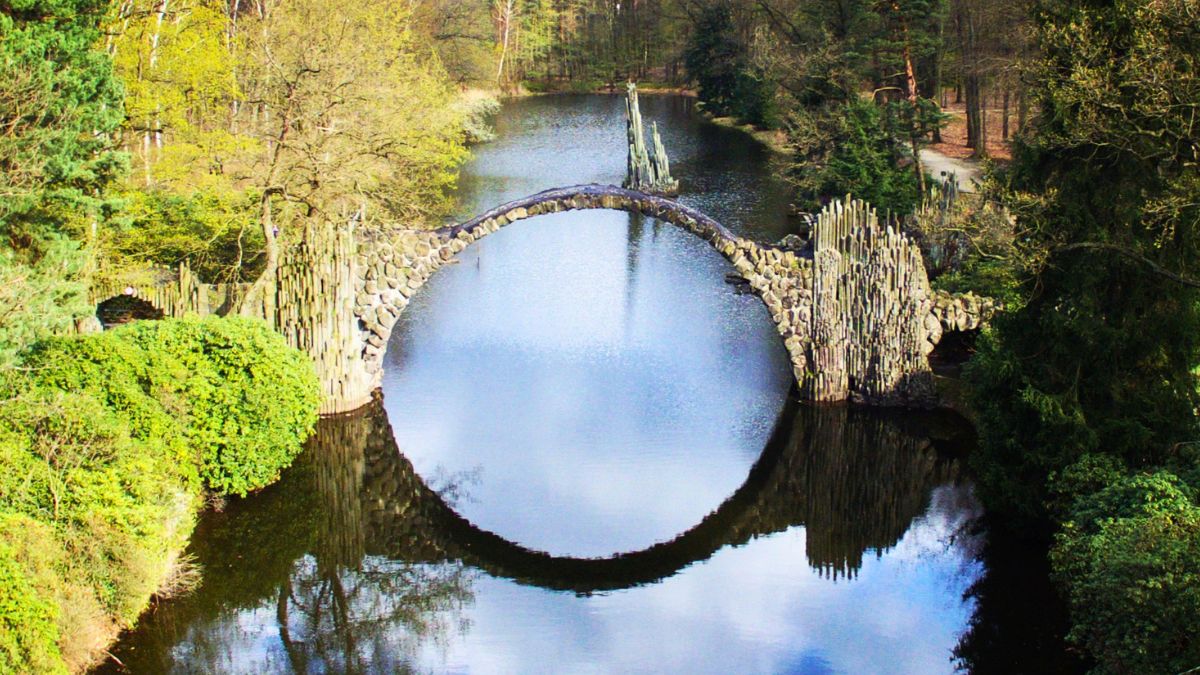
Tucked away in the Kromlau Park in the German state of Saxony, there is a bridge that has been stopping people in their tracks for well over a century. Known as Rakotzbrücke, and affectionately nicknamed the Devil’s Bridge, this extraordinary structure has earned a reputation that extends far beyond the borders of Germany. When its slender stone arch meets its own reflection in the still waters of Lake Rakotzsee below, the result is a breathtaking optical illusion of a perfectly complete stone circle. It is the kind of sight that makes you pull out your camera before you even fully register what you are looking at.
What makes Rakotzbrücke especially fascinating is that it was never designed to actually get anyone from one side to the other in any practical sense. The bridge was commissioned in 1860 by a local landowner named Friedrich Hermann Rötschke, who wanted to create a striking artistic feature within the natural landscape of his park. Its sole purpose was and has always been aesthetic, making it one of the rare examples in history of a structure built purely to be beautiful. The entire construction, including the artificial rock formations placed in the surrounding lake, was made from basalt columns transported from distant quarries. The arch was engineered with remarkable precision so that its reflection in calm water would form that mesmerizing, unbroken circle.
In European folklore, bridges of extraordinary technical ambition were often said to be the work of the devil himself, since humans alone were assumed incapable of such feats. Rakotzbrücke carries that same mythical weight, and the legend attached to it is genuinely entertaining. According to local storytelling, the builder struck a deal with the devil in order to complete the bridge, and in return the devil demanded the soul of the first being to cross it. The clever builder managed to outsmart his supernatural business partner by sending a dog across first, sparing any human soul from the bargain. Whether you take the legend seriously or not, it adds a wonderfully eerie layer to an already otherworldly place, and some people even interpret the perfect circle motif as a symbolic portal to another dimension.
The bridge sits at the heart of the Azaleen- und Rhododendronpark Kromlau, a sprawling green space covering roughly 198 acres. The park draws visitors throughout the year, but it is particularly magical in spring when rhododendrons and azaleas burst into bloom, and again in autumn when the foliage turns and the warm colors reflect beautifully in the water alongside the bridge. Despite its popularity as a photography destination, walking across Rakotzbrücke is strictly forbidden. The structure is considered historically fragile, and authorities take its preservation seriously. After years of careful work, a comprehensive restoration was completed in 2021, ensuring that future generations will still be able to stand at the water’s edge and marvel at this stone circle that appears to defy reality.
It is rare to encounter a place where human creativity and natural surroundings complement each other so completely. Rakotzbrücke is not just a clever architectural trick but a monument to a romantic vision that believed beauty itself was reason enough to build something. The optical illusion it creates is so convincing that even knowing the science behind it does not diminish the wonder of seeing it for yourself. It remains one of those destinations that feels almost too perfect to be real, like something lifted from a fairy tale and gently placed in the German countryside for the rest of us to find.
If you have ever visited the Devil’s Bridge or have this destination on your travel list, share your thoughts in the comments.