
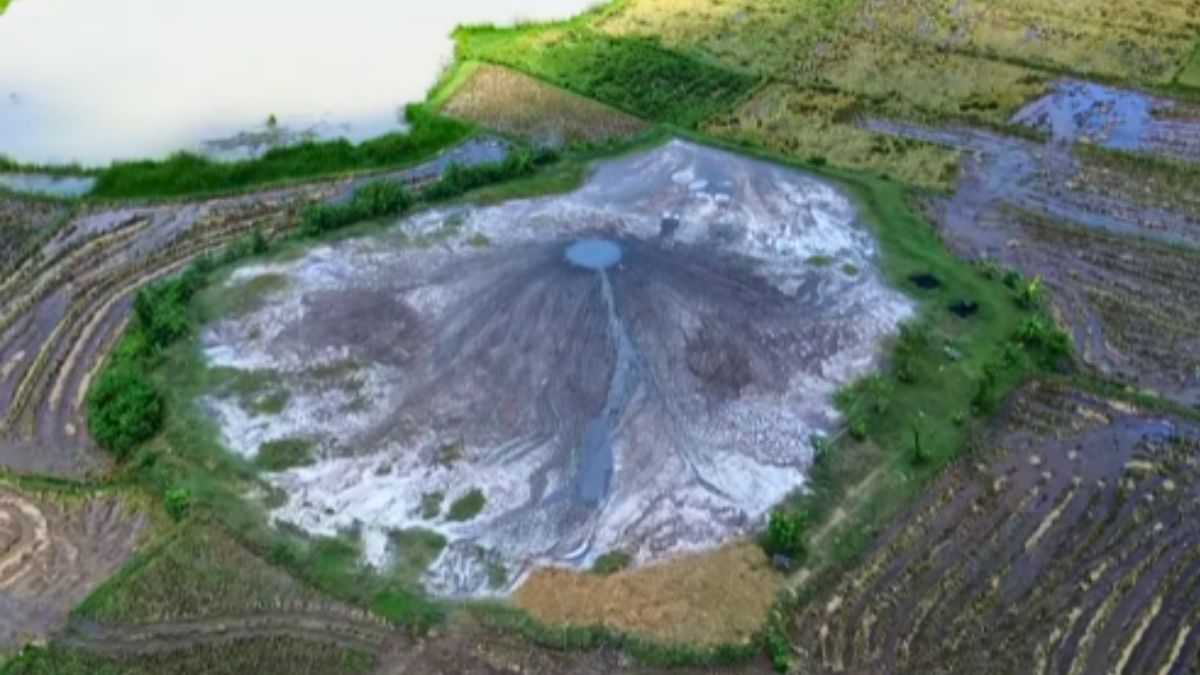
A Strange Mud Volcano in Central Java Is Drawing Tourists but Experts Are Urging Caution
Tucked away in the Grobogan region of Central Java, Indonesia, there is a geological oddity that has been quietly bubbling away for centuries and is now suddenly grabbing the world’s attention. Instead of shooting out lava like a traditional volcano, this formation pushes thick gray mud toward the surface, accompanied by deep, rumbling sounds that locals compare to muffled explosions. The site is called Bledug Kramesan, and its name actually tells you everything you need to know. In Javanese, “bledug” translates to “explosion,” referring to the sound the mud bubbles make when they burst, while “kramesan” simply points to the rice fields surrounding the crater.
From a scientific standpoint, what is happening here is categorized as a mud diapir, a geological structure that forms when low-density, unstable underground materials push their way up through softer sedimentary rock layers. Unlike conventional volcanoes driven by magma, the force behind Bledug Kramesan is pressurized gas and mud working their way through cracks in the earth. The resulting landscape is unlike almost anything else on the planet, constantly shifting as craters erupt with enormous mud bubbles that slowly deflate and reshape the terrain. The mud structure itself rises to about 82 feet above the surrounding land, features a crater roughly 16 feet wide at the top, and is believed to reach depths of approximately 131 feet.
What makes the recent buzz around this place even more interesting is that the activity level has noticeably picked up. Geologists have linked this surge in activity to a magnitude 6.5 earthquake that struck near the island of Bawean on March 22, 2024. The theory is that the quake reactivated existing fault lines in the earth beneath the region, essentially opening up easier pathways for gases and mud to reach the surface. It is also worth noting that Bledug Kramesan is not entirely alone in the area since the more widely known mud volcano Bledug Kuwu sits nearby, pointing to the broader geological restlessness of this whole region of Central Java.
@diyari1415 Wisata Grobogan 📍Bledug Kremesan #wisata #alam #gunung #pegunungan #grobogan #jawatengah #pesonaindonesia ♬ Nature and its beauties – rest of the soul & soul frequency
For the people living in the village of Sendang Rejo, which sits close to the site, this phenomenon is simply part of everyday life. Residents, including children, regularly watch the mud bubbles burst from what they consider a safe distance, and the activity has long been woven into local culture. Many farmers in the area hold the belief that the mud seeping from the volcano actually enriches the surrounding soil, contributing to the fertility of their rice paddies. Whether or not that belief holds up scientifically, it speaks to the deep familiarity these communities have developed with a feature of their landscape that the outside world is only now discovering.
Social media has played a massive role in putting Bledug Kramesan on the map for travelers, and tourist visits have been climbing steadily as a result. The visuals of large gray bubbles bursting from the earth are undeniably captivating and have spread rapidly online. However, Indonesia’s Geological Survey has been monitoring the area closely and has made clear that there are real risks involved in getting too close. The main concern is the possibility of ground collapse near the crater’s edge, which could happen with little warning given how unstable the terrain naturally is. Authorities have urged both locals and visitors to stay calm but cautious, and to respect the safety boundaries that have been established around the site.
This is one of those rare places where the planet’s inner workings are visible in a way that feels almost surreal, and it serves as a reminder that the earth is never truly still. The appeal is completely understandable, but so is the need to approach natural phenomena like this with a healthy respect for the forces involved. If you find this kind of geological wonder as fascinating as we do, share your thoughts in the comments.